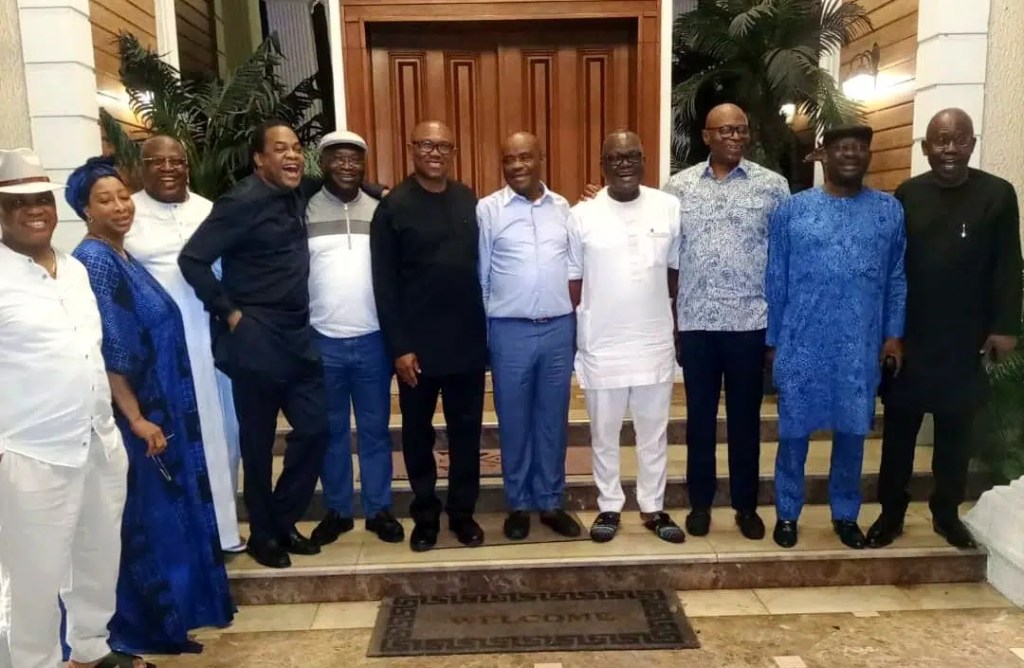
The recent meeting between the camp of Rivers State Governor Nyesom Wike and Labour Party (LP) presidential candidate, Peter Obi, may have unsettled forces in the Peoples Democratic Party (PDP).
Naija News gathered that Peter Obi had held talks with Wike and his loyalists over backing his presidential bid in 2023.
Those at the meeting held in Port Harcourt, the Rivers State capital, included Governors Okezie Victor Ikpeazu (Abia), Samuel Ortom (Benue), former governors Donald Duke (Cross River), Olusegun Mimiko (Ondo); Senator Olaka Nwogu, Dan Orbih, and Nnenna Ukeje, among others.
Wike loyalists were in Rivers State on Monday in preparation for the reconciliation meeting with Abubakar’s team, but they were told the parley would no longer hold.
A source revealed that Wike’s loyalists, disappointed that Atiku’s camp postponed the meeting without adequately communicating with them, later accompanied the Rivers State Governor to the birthday celebration of former Governor Peter Odili.
The source told The Nation: “There was supposed to be a reconciliation meeting between the team of Governor Nyesom Wike and that of the PDP Presidential Candidate, Atiku Abubakar. The meeting was supposed to hold at Wike’s private residence in Port Harcourt.
“While Team Wike was present, the team of Atiku Abubakar did not come. They didn’t communicate any shift of the meeting to Team Wike.
“The Wike’s team was already in Port Harcourt when it learned that Atiku’s team was no longer coming.
“They shifted the meeting to this weekend. Wike’s team then accompanied the governor to the birthday celebration of former Governor Peter Odili.”
According to the source, Peter Obi, who learned that Wike and his loyalists had converged in Port Harcourt, decided to rush down to meet with them.
The source added: “Someone must have told Obi about the presence of Wike’s team. He rushed down to Port Harcourt. He simply wanted to take advantage of the opportunity. They all met behind closed doors.
“Though the subject matter was not disclosed, it bordered on the 2023 presidential election. He wanted Wike and his team to support him. Obi didn’t attend Odili’s birthday.”
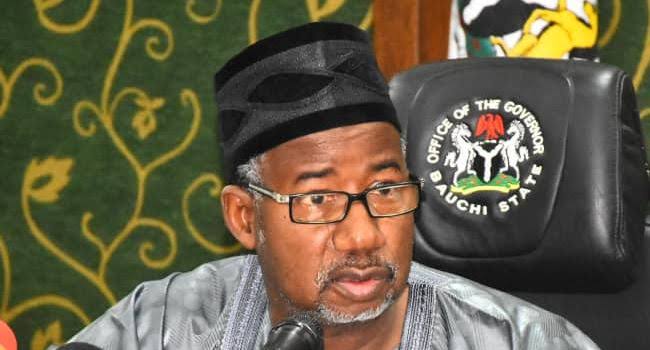
BAUCHI State governor Bala Muhammad has been called out for allegedly disregarding the report of the #EndSARS panel, constituted to investigate cases of police brutality in the state.
The allegation was made in a statement titled, ‘Abandonment of the report of the END SARS panel in Bauchi State and the total disregard of human rights and its future implication on security and youths restiveness’.
The statement, issued by a lawyer, S.G Idrees, was dated August 16, 2022.
According to Idrees, the governor neglected the report of the Justice Habibu Idris-led panel.
Noting that his Chambers, S. G. Idress & Co, was among those who presented petitions before the panel, the lawyer bemoaned the failure of the governor to acknowledge the panel’s recommendations.
“When the End SARS Panel was inaugurated in October 2020, many peace loving people in Nigeria and Bauchi State in particular thought an opportunity for them to get a long awaited justice and redress for years of police brutality has finally come home to roost.
“The Panel was well assembled in Bauchi State consisting of very sound and well-articulated men of immeasurable wealth of experience comprising of retired Justice as Chairman, retired Commissioner of Police, Chief Magistrate, Senior Counsels from Ministry of Justice, Senior Members of the Bar, Senior Civil Servants retired and serving.
Just looking at the composition one will expect and think of a serious venture, but that is not to be in the end after tedious months of serious engagement, deliberation, presentation of Petitions, witnesses, evidences and so forth and so on,” parts of the statement read.
Idrees, who said the panel was inaugurated along with a Trust Fund for victims of police brutality, noted that its report has been ready for over six months.
According to him, the panel heard 26 petitions and struck out six petitions out of 32 petitions it received.
“The recommendations of the Panel to the Governor of Bauchi State on all the Petitions entertained by it is now ready awaiting submission to the Governor for onward transmission to the Federal Government. And since that is yet to be done, it will be foolhardy for us to blame the Federal Government for deceiving Nigerians or Bauchi State citizens on the issue.
“We wish to call on the attention of the Governor of Bauchi State and remind him of his solemn oath of office, which is valid until the 29th day of May, 2023. In which period he is not only expected as a Muslim, to only be accountable to man, but equally to the creator of man.
“The summation of this letter is to draw your attention to your responsibility to your people who trusted you with their lives and general well being, so as to hasten things up before it is too late to rectify,” the statement added.
Efforts by The ICIR to get the reaction of the Bauchi State government were not successful.
The six-month old strike by the Academic Staff Union of Universities (ASUU) will continue after a meeting between the union and the Federal Government ended without an agreement.
The striking lecturers had met with the Professor Nimi Briggs Committee on Tuesday at the National University Commission in Abuja with high hopes of resolving the impasse.
A senior member of ASUU said members of the Briggs renegotiation committee did not come with any new offer on the table, Channels Television reported.
Instead, the ASUU source said, the committee pleaded with the lecturers to suspend the ongoing strike, with promises that their concerns will be included in the 2023 budget.
According to the source, the meeting, which started at about 12 noon, lasted for about three hours without any agreement reached.
ASUU embarked on a four-week warning strike on February 14.
On March 14, the union extended the industrial action by another two months to allow the government meet all of its demands. A 12-week extension was announced on May 9.
Since May 9, the union has remained on strike, vowing to persist until its demands are met.
The academics are seeking improved welfare, revitalisation of public universities and academic autonomy among other demands.
One bone of contention for the academics is the non-payment of university revitalisation funds, which amounts to about N1.1 trillion.
But the Federal Government has said it doesn’t have the money to pay such an amount.
The agreement was struck in 2009 during the PDP administration.
Another is the issue of the Integrated Payroll and Personnel Information System (IPPIS).
The academics proposed an alternative payroll system, the University Transparency and Accountability Solution (UTAS).
Peoples Democratic Party (PDP) presidential candidate, former vice president Atiku Abubakar, yesterday said Nigeria can only shift from being a “net importer” to a “net exporter” through extensive reforms to restore investor confidence which is currently at its lowest ebb.
He further said it is regrettable that Nigeria’s core infrastructure sectors are not operating efficiently.
Atiku stated this while reacting to observations by the National Union of Electricity Employees (NUEE) to his agenda on the development of the critical infrastructure needed to unleash the full potentials of the nation’s economy.
Atiku, in a statement signed by his media aide, Paul Ibe, said Nigeria must increase the stock and improve the quality of its infrastructure to build it economy, adding that inadequate infrastructure has been identified as the most problematic factor for doing business in Nigeria.
The PDP candidate who stated that the reaction of NUEE was reflective of the fact that Atiku’s policy prescriptions contained in “My Covenant With Nigerians” are getting due attention,
said, it is important to emphasise that actively promoting private sector participation in infrastructure development will be beneficial to the economy.
“It is also inevitable that we incentivize the private sector to take risk and invest in the economy for the following reasons.
“There is no telling that Nigeria’s huge infrastructure deficit is making businesses uncompetitive and stunting economic growth.
of efficient infrastructure, including roads and rail transportation, communication, adequate power etcetera is extremely important for the economy to grow and create much-needed jobs.
“Therefore, to build the economy of our dreams, we must increase the stock and improve the quality of our infrastructure. Inadequate infrastructure has been identified as the most problematic factor for doing business in Nigeria.
“In terms of actual spending, Nigeria currently spends less than 1% of its annual GDP on infrastructure as against the required levels of between 3%-5% of annual GDP. This shortfall has created a deficit, estimated
at USD 3 Trillion over the next 30 years. Our overwhelmed public sector does not have the resources or expertise to deliver. While our financing requirement is approximately 100 billion USD per annum, Nigeria’s entire budget is only USD 30 billion. The National Development Plan envisages that 80% of all investments will come from the private sector.
“Regrettably, Nigeria’s core infrastructure sectors are not operating efficiently. Almost all the infrastructure sectors from roads, railways, housing, power, and energy are operating below potential. Over the years, we have observed how these enterprises consume huge public resources while offering poor quality services. Many of these State-owned Enterprises have become a source for political patronage, corruption, and rent seeking to the detriment of Nigeria’s long-term economic growth.
“For example, Nigeria’s refining infrastructure remains poor despite the perennial injection of unending public resources for turnaround maintenance. The country’s refining capacity per capita is 0.002 bpd/capita compared to Libya’s 0.06 bpd/capita and South Africa’s 0.01 bpd/capita.
As of today, Nigeria imports over 80% of its refined products to meet its current needs and is said to be the largest importer of PMS in the world, with significant balance of trade implications.
“Sadly, the fiscal cost of maintaining these State-Owned Enterprises is enormous, and it comes with even greater opportunity costs. By holding unto these underperforming enterprises, Nigeria is sacrificing investments in critical areas, including education, health, water, sanitation, and rural infrastructure.
“For example, the first phase in the rehabilitation of Nigeria’s refineries is expected to gulp US$1.55 billion! With its current precarious fiscal position and daunting development challenges, Nigeria cannot afford to forego productivity enhancing investments in human capital development and channel scarce resources to moribund enterprises.
“We need to stress that the vision of Atiku Abubakar as encapsulated in “My Covenant With Nigeria” is to drive private investment to shift Nigeria from being a “net importer” to a “net exporter” of petroleum products and become the refining hub of the entire West Africa region. We cannot hope to achieve this without extensive reforms to restore investor confidence which is currently at its lowest ebb.
The active participation of the private sector in the downstream sector will help drive efficiency and healthy competition in the oil and gas sector.
“According to the Bureau of Public Enterprises 67% of the 142 privatized firms are performing. It must be noted that several firms, not just liberalised enterprises, are facing business environment challenges in Nigeria. Many have closed and or been forced to relocate to neighbouring countries because of the poor business environment.
“There is no denying the fact that Nigeria has derived enormous benefits from the creation of a liberal environment to facilitate private sector participation in key sectors of the economy. Today, the IT sector is undeniably the fastest growing services sector in the Nigerian economy. We need to replicate these efforts by extending the reform initiatives to other sectors.
“Of course, different countries have implemented liberalisation programmes with varied outcomes and over time and space just as other policies. But it is easier to point to success stories around the world: from Vietnam to Mexico; from Indonesia to South Africa and Egypt etcetera than outright failures. For the avoidance of doubt, liberalisation and deregulation programmes have supported the private sector to unleash its growth potentials and enabled these governments focus on investing in education, healthcare, poverty alleviation, water and sanitation with such proceeds.
“Every reform measure has the potential to create difficulties e
specially in the short-term, but with a positive impact on incomes, employment, and poverty, over the medium and long-term.
Liberalised firms may face difficulties as they transit from the old culture of rent seeking and dependence on government for survival, to a new business culture that is driven by efficiency and competition. But Atiku Abubakar will ensure that his economic reform measures are accompanied by a series of mutually supportive activities aimed at easing these difficulties and making the reform measures impactful.
“Finally, we shall not hold brief for the BPE, as they are best suited to answer some of the questions raised by NUEE for example, who bought the companies and what process was followed etcetera,” he said
A Catholic priest, Rev Fr Kelvin Ugwu, has called on Nigerians to ignore the recent prophecy by the founder of Adoration Ministry, Enugu, Fr. Ejike Mbaka, against the Labour Party presidential candidate, Peter Obi.
Mbaka, a fiery Enugu Catholic priest, had declared that Peter Obi cannot emerge as Nigerian President in 2023, saying the Labour Party candidate is too stingy.
Mbaka’s comment is currently generating reactions from the teaming supporters of Obi.
Reacting, Fr Kelvin, a Nigerian Catholic priest serving in Malawi, said in a post on his verified Facebook page that such prophecies had plunged the entire nation into ‘purgatory’ in previous election years.
DAILY POST recalls that Mbaka had in 2015, declared that President Muhammadu Buhari was a messiah chosen by God to take the country to its promised land.
But the controversial priest had, however, attacked Buhari’s government over alleged corruption, stating that the president was being controlled by some cabals in the Aso Rock
According to Fr Kelvin, in the past, we have listened to self-acclaimed prophets tell us who to vote for. We tried them many times, but they landed us in purgatory. This time around, we have decided not to follow prophecies.
On the stingy comment by Mbaka, Fr Kelvin opined that Nigerians had “tried candidates that used to share money. We voted for those that will distribute oils, Maggi, indomie, and 1k before the camera, but it landed us in hell”.
“This time around, we have vowed never to listen to any self-acclaimed prophet and their prophecies. We are not saying prophecy is not good, but we are saying that the biggest prophecy from God in the 2023 election is for us to use our common senses, which God gave us.
“Finally, we have also vowed not to give shishi when you don’t merit it. We will not bribe anybody. We will not be wasteful. Shishi you will not see unless we see the importance of the project to the masses”.
Senator representing Oyo South Senatorial District, Kola Balogun, has formally defected from the Peoples Democratic Party (PDP) to the ruling All Progressives Congress (APC).
Balogun’s notice of defection was contained in a letter addressed to the Senate President, Ahmad Lawan, and read at the start of plenary on Wednesday.
His defection brings the number of APC Senators in the upper chamber to 70.
According to the lawmaker, his decision to defect from the PDP was due to the lack of internal democracy in the party at the state level for the emergence of leaders and representatives.
He added that the development has further led to the existence of several factions and aggrieved groups within the party.
Balogun’s defection letter reads in part, “The decision to resign was informed by the Oyo State Governor’s reign of impunity that had led him into supplanting the constitutional assigned roles of party bureaucrats and party stakeholders and replacing them with unilaterally declared decisions on who and who should emerge as the legitimate representatives of the people.
“This unconstitutional, flagrant and dictatorial procedural breeches for the emergence of leaders and representatives of the people has led to the factionalisation of the party, this breeding several aggrieved groups within the party and mass exodus of key leaders from the party.
“This development has laid the foundation for the failure of the party at subsequent polls and also stand to jeopardize the political future and interest of my people, who had worked assiduously to get me elected in the 2019 February elections.
“Rising from the meeting of the key stakeholders in my district, on 27th April, 2022, my people unanimously decided that I should resign my membership of the People’s Democratic Party as they were ready to also rain and decamp en masse with me to the All Progressives Congress with immediate effect.
“This notification becomes exigency in order to intimate the Distinguished Members of Senate with the recent political developments in the PDP-led administration in Oyo State, and the direction in which my people and I are presently focused.”
Ogieh, had in April 2022 resigned his position as Managing Director, of DESOPADEC to contest the just concluded Peoples Democratic Party, (PDP) primaries for the Isoko Federal House of Representatives but he was defeated.
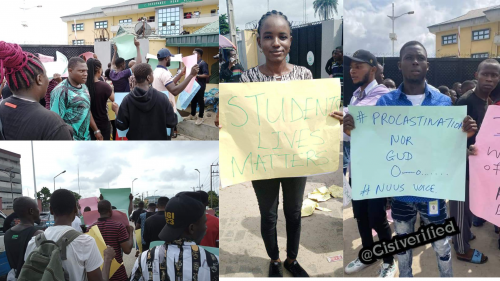
Delta State students studying in tertiary institutions across Nigeria, on Wednesday protested against the Managing Director, of the Delta State Oil Producing Areas Development Commission, (DESOPADEC), Askia Ogieh, for alleged refusal to pay them their three years’ bursaries.
Ogieh, had in April 2022 resigned his position as Managing Director, of DESOPADEC to contest the just concluded Peoples Democratic Party, (PDP) primaries for the Isoko Federal House of Representatives but he was defeated.
Surprisingly, he got reappointed on Tuesday by Governor Ifeanyi Okowa. The students numbering over 5000, brandished placards of different inscriptions such as “Students lives matter”, “We need our bursary, education is now expensive”.
“Askia has used our money to run his PDP House of Representatives primary”. “Askia paid each delegates N3 million during the PDP house of representatives primary but denying us our rights” “We need our bursary”, DESOPADEC is bleeding because of the looting of our common wealth,” and “Delta politicians have finished DESOPADEC.”
SaharaReporters reliably gathered that the aggrieved students who stormed the headquarters of the commission in Warri, immediately barricaded the entrance gate of the commission, demanding for their three years bursaries. The students alleged that the commission’s MD had refused to pay them their bursaries for the past three years before he resigned few months ago to contest an election.
Speaking to SaharaReporters, one of the students who simply identified himself as Oghenekevwe, noted that “The essence of this DESOPADEC bursary was to help those Nigerian undergraduate students that come from the Oil Producing Areas in Delta State. But rather than paying us this bursary, politicians at the helm of affairs of the commission, will use our money for their personal gains.
The MD, Askia, is just enriching himself in that commission while we students suffer. For three years now, Askia has not paid us our bursary, but he has millions of naira in dollars to buy delegates’ votes during the PDP primaries where he contested for the House of Representatives in Isoko federal constituency.”
Other students who spoke to SaharaReporters, condemned the non-payment of their bursary for the past three years, an act they described as “wickedness of the highest order”, adding that from good authorities, the money for the bursary had been released long ago by the state government and wondered why till date no dime had been given to them.
Addressing the protesting students, Head of Department, (HOD), social services, Harriman Aghogho, appealed to the students to remain calm and law abiding as the process to address their agitation was already on.
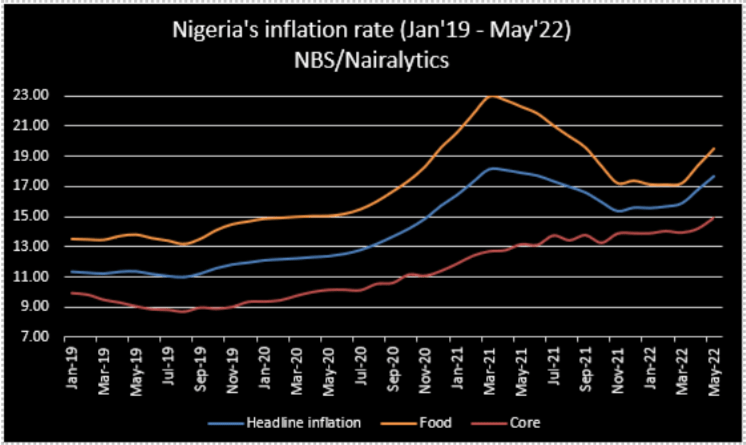
Nigeria’s inflation rose to its highest level in 11 months, rising from 16.82% recorded in April 2022 to 17.71%. This is according to the recently released Consumer Price Index report, released by the National Bureau of Statistics (NBS).
The consumer price index, which measures the rate of inflation rose by 17.71% year-on-year in May 2022, which is 0.89% points higher than the 16.82% recorded in the previous month (April 2022). On a month-on-month basis, the headline index increased by 1.78% in May 2022, compared to the 1.76% increase recorded in the previous month.
Similarly, the urban inflation rate increased to 18.24% (year-on-year); this is a 0.27% decline compared to 18.51% recorded in May 2021.
On the other hand, the rural inflation rate increased to 17.21% in May 2022 (year-on-year) basis; this is a 0.15% decline compared to 17.36% recorded in the corresponding month of 2021.
Food inflation
The closely watched index rose by 19.5% year-on-year in May 2022, representing a 1.13% points uptick compared to 18.37% recorded in the previous month and 2.78% decline compared to the corresponding period of 2021 (22.28%).
This rise in the food index was caused by increases in prices of Bread and cereals, Food products, Potatoes, yam, and other tubers, Wine, Fish, Meat, and Oils.
On a month-on-month basis, the food sub-index increased to 2.01% in May 2022, up by 0.01% points from 2.0% recorded in April 2022. Also, the average annual rate of change of the Food sub-index for the twelve-month period ending May 2022 over the previous twelve-month average is 18.68%, 0.05% points decline from the average annual rate of change recorded in May 2021 (19.18%).
Core inflation
The “All items less farm produce” or Core inflation, which excludes the prices of volatile agricultural produce stood at 14.9% in May 2022 on a year-on-year basis, up by 0.72% points compared to 14.18% recorded in April 2022 and 1.75% points higher than the 13.15% recorded in May 2021.
In the month under review, the highest increases were recorded in prices of Gas, Liquid fuel, Garment, Solid fuel, Cleaning, Repair and Hire of clothing and Passenger transport by road.
The average 12-month annual rate of change of the index was 13.83% for the twelve-month period ending May 2022; this is 2.33% points higher than 11.5% recorded in May 2021.
States with the highest inflation
In terms of all-items inflation, Bauchi State recorded the highest at 20.62% in the month of May 2022, closely followed by Akwa Ibom and Rivers with 20.34% and 19.95% respectively, while Kwara (15.45%), Kaduna (15.69%) and Jigawa (16.15%) recorded the slowest rise in headline Year on Year inflation
Considering the food index, Kogi state recorded the highest food inflation in May 2022 with 22.79%, followed by Akwa Ibom at 22.47% and Kwara State with 22.21%. On the flip side, Kaduna (16.46%), Anambra (16.54%) and Jigawa (16.91%) recorded the slowest rise in year-on-year food inflation.
Backstory
Nigeria’s inflation rate rose to its highest level in 8 months after the headline index grew by 16.68% year-on-year in the month of April 2022, compared to 15.92% recorded in the previous month. Food inflation also rose to 18.37% as a result of the global energy and food crises, pushing Nigeria’s food inflation rate to its 7-month high.
What this means
The purchasing power of Nigerians is constantly and continually eroded by the rising prices of food and services in the country. This implies that the value of money is worth as much as it was in the previous month. Although inflation seems like a common event in the country from times past, the pace at which the rate rises is somewhat worrisome.
The Central Bank in its last monetary policy meeting raised the benchmark interest rate from 11.5% to 13% in May 2022, in a bid to curb the galloping inflationary pressure in the country, which has been attributed to global energy and food crises.
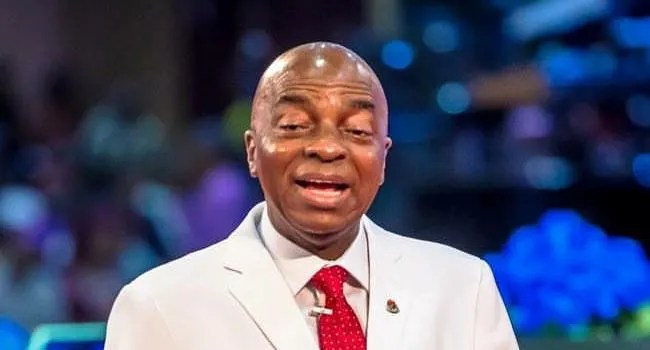
Femi Adesina, the Special Adviser to the President on Media and Publicity, on Tuesday, accused Bishop David Oyedepo, the founder of Living Faith Church, aka Winners Chapel, of harboring animosity for President Muhammadu Buhari.
On Monday, June 13, 2022, during a church service titled Special Prayer for the Nation, Oyedepo bemoaned the deep pain inflicted on Nigerians by official corruption.
Buhari’s government, according to Oyedepo, is the most evil and corrupt in Nigeria’s history.
The Federal Government claimed to be combatting corruption, yet its officials, according to the cleric, are extremely corrupt.
He stated that the N80 billion stolen by the Federation’s Accountant-General, Ahmed Idris, would be sufficient to meet the demands of the Academic Staff Union of Universities (ASUU).
Adesina on Tuesday however, said that Bishop Oyedepo’s words, however, were borne out of his blind hatred for President Buhari.
His tweet reads: “The bishop at Ota can’t even get his facts right. Blinded by hatred for PMB, he says Auditor-General stole N80bn.
“Pity! He doesn’t know the difference between Accountant-General (only alleged) and Auditor-General. Like OBJ said long ago, we should begin to ordain our own bishops.”
The Presidential candidate of the All Progressives Congress (APC), Bola Ahmed Tinubu, has said that members of the ruling party have settled their internal issues.
Tinubu stated this in Ado-Ekiti on Tuesday at a mega rally held to canvass votes for the APC governorship candidate, Biodun Abayomi Oyebanji, ahead of Saturday’s election in the state.
He stated that the ruling party has settled its differences and is now united to achieve victory in the Ekiti governorship election and retain power at the centre in 2023.
Tinubu commended Buhari for supporting the clamour for the return of power to the South in 2023 with him emerging as the APC Presidential candidate to unite the country.
He said: “President Buhari is a man of integrity, honour is better than riches. He has said we (APC) are going back to South for the next President of Nigeria and he has kept that promise for us and it is now left for us to work for the progress and unity of Nigeria.
“There is no house where we don’t have quarrels, democracy is full of twists and turns, hills and valleys. We will have quarrels but we will not burn down the house. I am a builder, a successful builder for that matter.
“Those of us that said we are fighting, you are lying. We have settled our quarrels. This is the first step in the elections ahead. The President has said I should be involved in this (Ekiti) election and we are going to succeed.”




 My Blog